An Indian Contemporary Artist Shaped by Admiration and Artistic Lineage
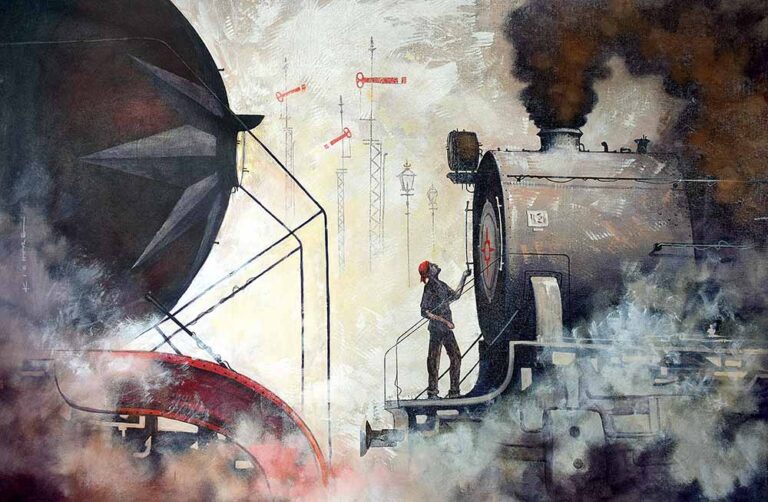
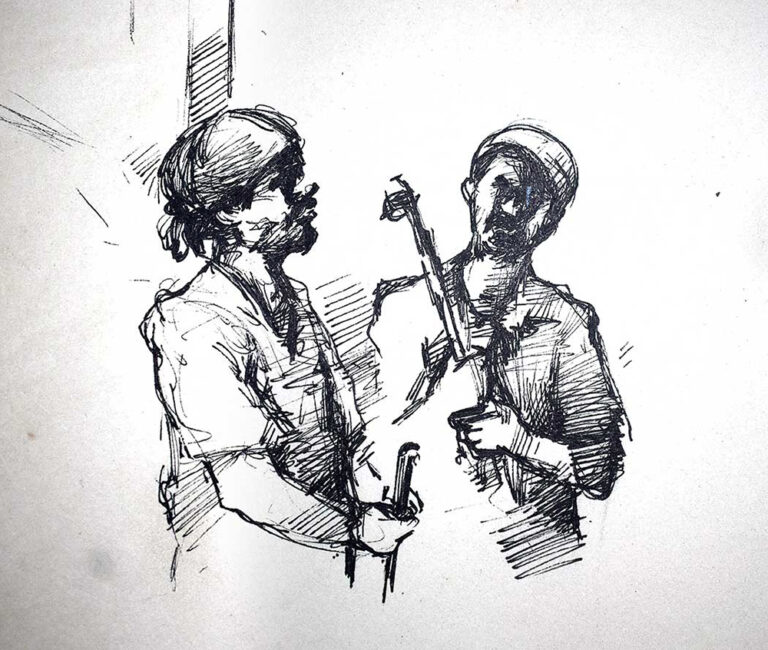
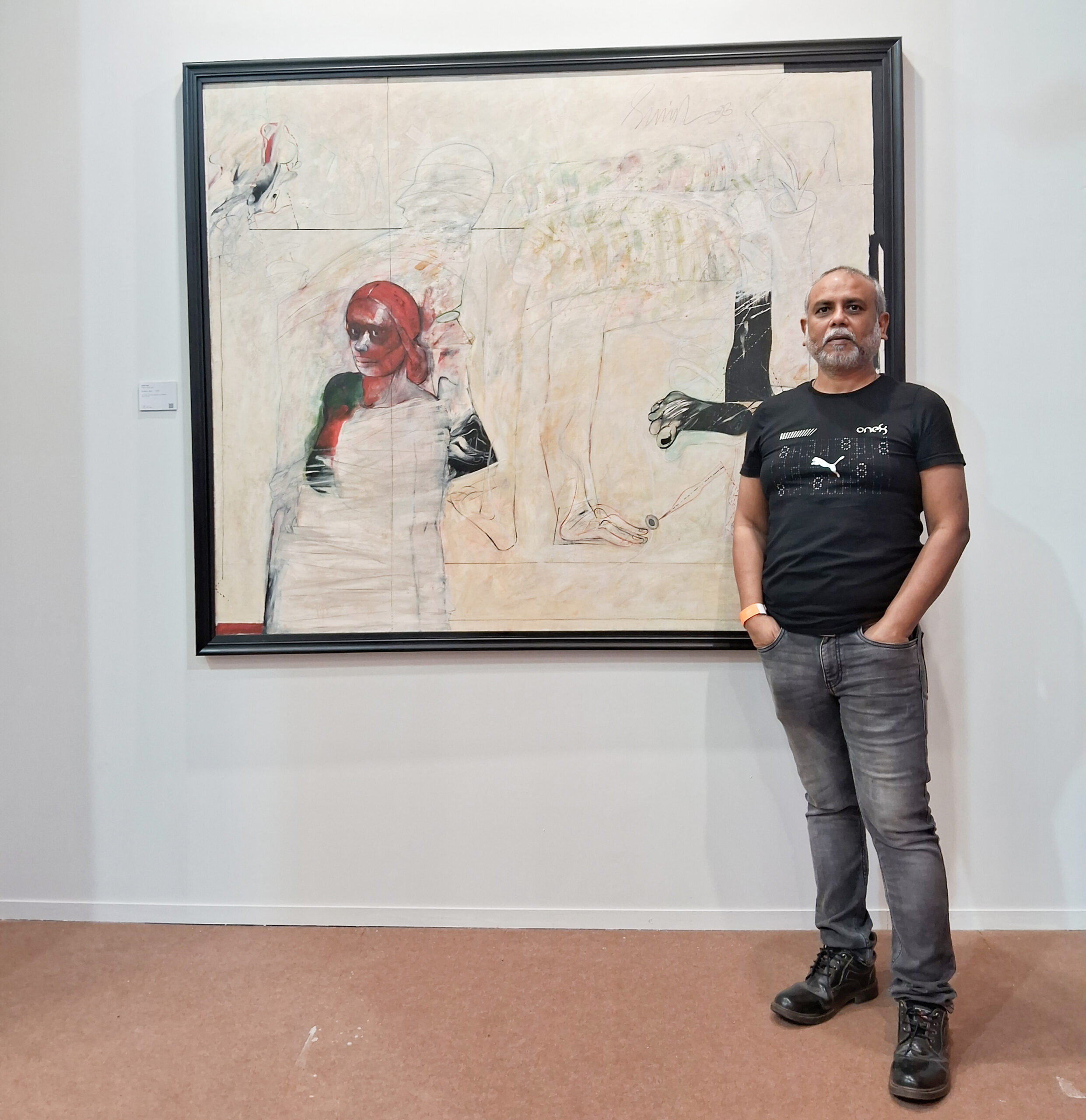
Every serious Indian contemporary artist carries within their practice a silent dialogue with the masters who shaped their way of seeing. For Kishore Pratim Biswas, that dialogue finds a powerful presence in the work of Sunil Das—one of India’s most uncompromising and influential modern artists. Kishore has openly acknowledged his admiration for Sunil Das’s paintings, particularly recognizing the raw strength of his drawing, the force embedded in his lines, and the fearless use of color.
This influence is not imitation, but resonance. Sunil Das’s work was never decorative; it was visceral, physical, and emotionally charged. His lines were not merely outlines—they were actions. For Kishore, encountering Sunil Das’s paintings was not simply about observing art; it was about understanding how energy, instinct, and discipline could coexist on the canvas. This understanding deeply impacted Kishore’s evolving language as an abstract Indian artist navigating the space between structure and freedom.
In the context of contemporary art in India, influence is often misunderstood as stylistic borrowing. However, Kishore’s engagement with Sunil Das’s legacy is philosophical rather than visual. It lies in the respect for drawing as the backbone of expression, and in the courage to let emotion dictate movement. This mindset places Kishore firmly among young Indian contemporary artists who value lineage while pushing toward new visual territories.
Sunil Das’s Paintings: The Power of Drawing and the Violence of Beauty
To understand Kishore Pratim Biswas’s artistic inclination, one must first understand what made Sunil Das’s paintings so distinctive in Indian modern art. Sunil Das was celebrated for his mastery over drawing—his lines were muscular, charged, and uncompromising. Whether depicting bulls, figures, or abstract forms, his work carried a sense of controlled aggression and emotional intensity.
Sunil Das treated drawing not as preparation, but as a final act. His lines possessed weight, rhythm, and direction. They suggested movement even in stillness. Color, when applied, did not soften the composition; instead, it amplified the emotional tension. This approach broke away from lyrical abstraction and introduced a more confrontational visual language into modern abstract art in India.
Kishore has often spoken about being deeply drawn to this force—this honesty of mark-making. For him, Sunil Das represented an artist who trusted the instinct of the hand as much as the intellect of the mind. This trust is critical in abstract practice, where meaning is not narrated but felt.
In today’s world of highly conceptualized contemporary art, Sunil Das’s paintings stand as reminders that drawing remains central to expression. It is this belief that Kishore carries forward, adapting it to his own emotional and contemporary context while building a bridge between past and present.
From Observation to Influence: How Sunil Das Shaped Kishore’s Artistic Thinking
Kishore Pratim Biswas’s acknowledgment of Sunil Das’s influence reflects maturity rather than dependency. Influence, in Kishore’s case, emerges through process, not appearance. His fascination lies in how Sunil Das used line as a carrier of emotion—how a single stroke could express tension, resistance, or release.
As Kishore gradually moved toward modern abstract art, this understanding became increasingly significant. His own work began to prioritize gesture, movement, and rhythm. Lines in his paintings are not passive; they assert presence. Color interacts with line rather than dominating it, creating a dynamic balance between structure and spontaneity.
This approach aligns Kishore with a thoughtful generation of young Indian contemporary artists who see abstraction as a space for emotional truth rather than decorative composition. While Sunil Das often expressed raw power and confrontation, Kishore’s work leans toward introspection and transformation. Yet, the shared respect for drawing remains a common thread.
In Kishore’s abstract works, one can sense the discipline behind the freedom. Every expressive mark is supported by an understanding of form and balance. This discipline is where Sunil Das’s influence quietly resides—not as visible homage, but as internalized strength. It allows Kishore to explore abstraction with confidence, making his work resonate within the broader discourse of contemporary art.
Modern Abstract Art and the Role of Line, Color, and Emotion
In the evolving landscape of modern abstract art, artists are often challenged to justify abstraction beyond aesthetics. Kishore Pratim Biswas addresses this challenge by grounding abstraction in drawing—much like Sunil Das did decades earlier. For Kishore, abstraction is not the absence of form, but the distillation of experience.
His paintings reveal an ongoing negotiation between control and surrender. Lines emerge with intention, yet retain a sense of instinct. Color is applied not to decorate, but to intensify emotional presence. This philosophy aligns his work with what many collectors and critics recognize as best abstract paintings—those that communicate without explanation.
Unlike purely conceptual abstraction, Kishore’s work remains tactile and human. The viewer can sense the physical act of painting—the movement of the arm, the pressure of the brush, the hesitation or certainty of a stroke. This physicality echoes Sunil Das’s belief that painting is an act of engagement rather than representation.
As an abstract Indian artist, Kishore occupies a space where tradition meets experimentation. He acknowledges the lineage of Indian modernists while responding to contemporary sensibilities. His abstraction does not seek to shock or confuse; instead, it invites prolonged engagement. This quality is increasingly valued in contemporary collections where emotional durability matters more than immediate impact.
Artistic Continuity and the Future of Indian Contemporary Abstraction
Kishore Pratim Biswas’s relationship with Sunil Das’s legacy represents more than admiration—it reflects continuity within Indian art history. In recognizing the importance of drawing, force, and color, Kishore aligns himself with a tradition that values authenticity over trend. This alignment strengthens his position as a serious Indian contemporary artist committed to artistic integrity.
As interest in contemporary art and modern abstract art grows both in India and internationally, artists like Kishore play a vital role in shaping its future. His work demonstrates that abstraction can be deeply personal, culturally rooted, and intellectually honest at the same time. The influence of Sunil Das serves as a compass rather than a destination—guiding Kishore toward deeper exploration rather than repetition.
Collectors increasingly appreciate this depth. They recognize that Kishore’s paintings are not isolated experiments, but part of a long, evolving conversation within Indian art. This understanding enhances the value of his work within the category of best abstract paintings emerging from India today.
Artishore.com stands as a platform documenting this journey—where influence becomes evolution, and admiration transforms into independent expression. Through his engagement with Sunil Das’s paintings and his own abstract practice, Kishore Pratim Biswas contributes meaningfully to the living narrative of Indian contemporary and abstract art.